Being underinsured rarely feels like a problem while everything is going fine. Your premium gets paid, your policy renews, and life continues as normal. The trouble with being underinsured is that it is invisible until the exact moment you need your coverage most, and by then it is too late to fix. Most people assume that having insurance automatically means they are protected, but having a policy and having adequate coverage are two very different things.
Here are the signs that your coverage may not actually match your real financial exposure, even if everything looks fine on paper.
Your Coverage Amount Has Not Changed in Years, But Your Life Has
Insurance policies are often set once, at a specific point in time, based on your circumstances at that moment. The problem is that circumstances change far more often than policies do. A coverage amount that made sense five or ten years ago may not reflect your current income, your current assets, your current dependents, or your current cost of living.
If you have gotten married, had children, bought a more expensive home, taken on a larger mortgage, or significantly increased your income since your policy was originally set up, and you have not revisited your coverage since, there is a strong chance your protection has not kept pace with your actual financial responsibilities. Coverage that once felt like plenty can quietly become inadequate simply through the passage of time and the accumulation of life changes.
You Chose Your Coverage Based on the Minimum Required, Not What You Actually Need
A lot of underinsurance starts at the very beginning, at the moment a policy is purchased. Many people select coverage based on what is legally required or what a lender requires, rather than what would actually be needed to cover a real, worst case scenario.
Minimum liability coverage on an auto policy, for example, is often set far below what a serious accident could actually cost in medical expenses, vehicle damage, and legal liability. Choosing the minimum keeps your premium low in the short term, but it also means that in a significant accident, the gap between what your policy pays and what you actually owe becomes your personal financial responsibility. That gap does not disappear. It becomes a bill, often a very large one, that lands directly on you.
You Have Never Actually Calculated Your Real Replacement or Rebuild Costs
This is one of the most common and most dangerous blind spots, particularly with home insurance and life insurance. Many people assume their coverage is based on their home’s market value or their general sense of what their family would need financially if something happened to them, without ever actually running the numbers.
Home insurance should reflect the actual cost to rebuild your home from scratch, including labor and materials at current prices, not what you paid for the house or what it would sell for today. Construction costs shift over time, sometimes significantly, and a rebuild estimate that was accurate years ago may be considerably lower than what it would actually cost today.
Life insurance should reflect what your dependents would actually need to maintain their standard of living, cover outstanding debts, and fund future obligations like education, not a round number chosen somewhat arbitrarily at the time of purchase. If you have never sat down and calculated these figures directly, there is a real chance your coverage is based on a rough guess rather than an accurate need.
You Have Made Upgrades or Acquired Assets Without Updating Your Policy
Every meaningful addition to your life, financial or physical, changes your actual risk exposure, but your insurance policy has no way of knowing that unless you tell it. A renovated kitchen, a finished basement, a new roof, valuable electronics, jewelry, or a home office full of expensive equipment can all increase what you would need to be made whole after a loss, yet none of it gets reflected in your coverage automatically.
If you have made any significant purchases or upgrades since your policy started and never called your insurer to update your coverage accordingly, there is a strong chance those additions are underinsured or not insured at all under your current policy limits.
You Are Relying on a Single Type of Coverage to Do Too Much
Some people assume their homeowners policy, auto policy, or employer provided benefits cover more than they actually do. Employer provided life insurance, for example, is often only equal to one or two times your annual salary, which sounds substantial until you calculate what your family would actually need to replace years of income, pay off a mortgage, and cover future expenses. Many people never purchase supplemental coverage because they assume their employer policy is sufficient, without ever checking the real numbers.
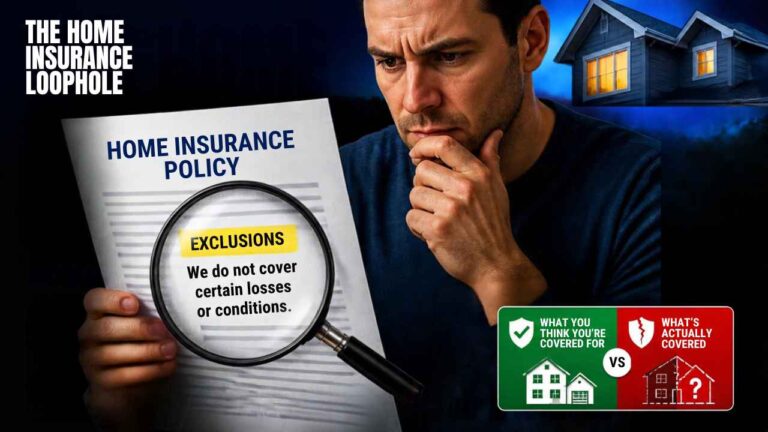
Similarly, homeowners policies often exclude specific high value items above a certain threshold unless they are separately scheduled, meaning expensive jewelry, art, or collectibles might only be covered up to a few thousand dollars regardless of their actual value, unless you specifically added a rider for them.
You Have Never Compared Your Coverage Against a Real Worst Case Scenario
This is perhaps the clearest sign of all. If you have never actually sat down and asked, what would happen financially if the absolute worst case occurred right now, a total loss of my home, a serious long term disability, a fatal accident, and then compared that scenario against what your policy would actually pay out, you genuinely do not know whether you are adequately covered. You only know that you have a policy, which is a very different thing.
Most underinsurance is discovered only after a real event forces the comparison, which is exactly the wrong time to find out there is a gap.
How to Actually Check Where You Stand
Closing this blind spot does not require an overhaul of your entire financial life. It requires a direct, honest review, ideally once a year or after any major life change. Start by listing your current assets, debts, dependents, and income, and compare that list against what your current policies would actually pay out in a worst case scenario for each one.
For home insurance, request an updated replacement cost estimate based on current construction prices, not an inflation adjusted version of an old number. For life insurance, calculate what your dependents would genuinely need to replace your income and cover major expenses, then compare that figure against your actual death benefit. For auto and liability coverage, consider whether the state minimum, if that is what you currently carry, would actually cover a serious accident given your assets and income.
If any of these comparisons reveal a meaningful gap, it is far better to address it through a straightforward conversation with your insurer now than to discover it during a claim, when adjusting your coverage after the fact is no longer an option.
The Bottom Line
Being underinsured is not usually the result of a single bad decision. It is usually the slow byproduct of a policy that stayed frozen in time while your actual life kept moving forward. The only way to know for certain whether your coverage still matches your real exposure is to stop assuming and actually run the comparison. For most people, that comparison takes less than an hour, and the peace of mind it provides, either confirming you are covered or catching a gap before it becomes a crisis, is worth far more than the time it takes.