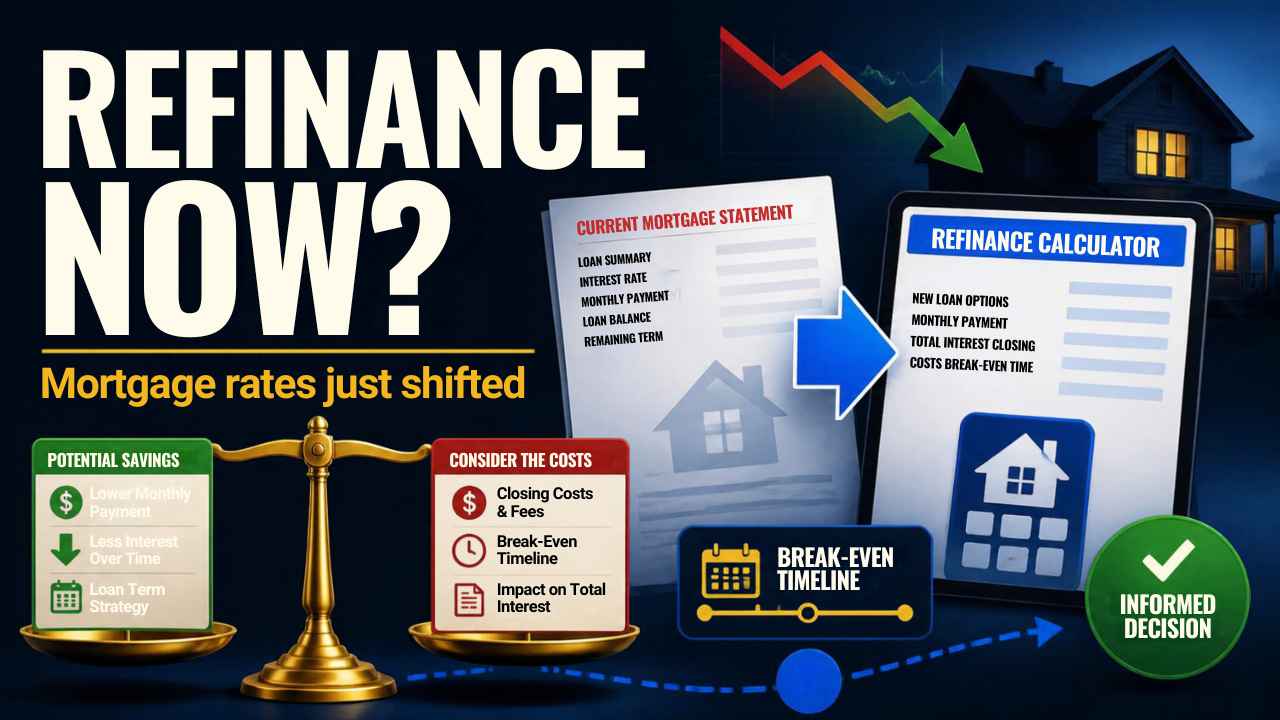
Mortgage rates rarely move in a straight line, and every time they shift even slightly, the same question resurfaces for homeowners everywhere: should I refinance right now? The honest answer is that it depends on numbers most people never actually sit down and calculate. Refinancing is not automatically a good idea just because rates dropped a little, and it is not automatically a bad idea just because closing costs feel intimidating. The real answer lives somewhere in the math, and most homeowners never get far enough into that math to know where they actually stand.
Here is how to think through it properly.
Why a Rate Shift Does Not Automatically Mean You Should Refinance
The instinct when rates drop is to assume refinancing is a straightforward win. Lower rate, lower payment, obvious choice. In reality, refinancing comes with real costs attached, and those costs need to be weighed against the actual savings over time, not just compared against your current rate in isolation.
Closing costs on a refinance typically include appraisal fees, origination fees, title insurance, and various administrative charges, and depending on your loan size and location, this can add up to a meaningful amount. These costs do not disappear just because rates went down. They are the price of accessing the new, lower rate, and the real question is how long it takes for your monthly savings to actually recover that upfront cost.
The Break Even Point Is the Number That Actually Matters
This is the calculation most homeowners skip entirely, and it is the single most important number in deciding whether refinancing makes sense right now. The break even point is simply the amount of time it takes for your monthly savings from the new rate to equal the total cost of refinancing.
If refinancing costs a certain amount upfront and saves you a specific amount each month, dividing the cost by the monthly savings tells you, in months, how long you need to stay in the home for refinancing to actually pay off. If you plan to stay in your home well beyond that break even point, refinancing likely makes financial sense. If there is a real chance you will sell or move before reaching that point, the refinance could end up costing you more than it saves, even with a genuinely lower rate.
This single calculation eliminates most of the guesswork, and it is the first thing worth doing before getting caught up in rate comparisons.
How Much of a Rate Drop Actually Justifies Refinancing
There used to be a rough rule of thumb floating around that refinancing only made sense if rates dropped by a full percentage point or more. That guideline is outdated and does not account for how loan size and how long you plan to stay in the home change the equation significantly.
On a larger loan balance, even a smaller rate reduction can translate into substantial monthly savings, potentially justifying a refinance well before hitting that old one percent benchmark. On a smaller loan balance, the same modest rate drop might barely move the needle once closing costs are factored in. This is exactly why running your own specific numbers matters more than following a generic rule that was never built around your actual loan.
Your Remaining Loan Term Changes the Math Significantly
Refinancing does not just change your rate. In many cases, it resets your loan term as well, and this detail gets overlooked constantly. If you are eight years into a thirty year mortgage and refinance into a brand new thirty year loan, even at a lower rate, you may end up paying more in total interest over the life of the loan simply because you have extended the repayment timeline back out to thirty years.
This does not mean refinancing later into your loan term is automatically a mistake, but it does mean the decision requires looking beyond the monthly payment. Refinancing into a shorter term, such as a fifteen or twenty year loan, at a lower rate can sometimes result in a similar monthly payment to what you are paying now, while saving a significant amount in total interest and paying off the home considerably faster. This option gets overlooked constantly because people focus purely on getting the lowest possible monthly payment rather than considering the total cost over time.
Cash Out Refinancing Is a Different Decision Entirely
Some homeowners consider refinancing not just to lower their rate, but to pull equity out of their home for other purposes, debt consolidation, home improvements, or other major expenses. This is a fundamentally different decision from a standard rate and term refinance, and it deserves separate consideration.
Cash out refinancing increases your loan balance, which means even with a lower rate, your monthly payment might not decrease as much as expected, or could increase depending on how much equity you are pulling out. It also means you are converting equity, an asset, into debt, which is not inherently wrong, but it should be a deliberate decision based on a clear purpose, not something that happens as a side effect of chasing a lower rate.
Your Credit Profile Affects What Rate You Actually Qualify For
The rate being advertised broadly in the news is rarely the exact rate every homeowner will actually be offered. Lenders price loans individually based on credit score, debt to income ratio, loan to value ratio, and several other factors specific to your financial profile.
If your credit has improved since you took out your original mortgage, paid down other debt, increased your income, corrected errors on your credit report, you may qualify for a meaningfully better rate than what is being generally advertised. On the other hand, if your financial picture has weakened somewhat, the rate you are actually offered might be higher than the headline number that prompted you to start looking in the first place. Getting a real, personalized quote is the only way to know where you actually stand, rather than assuming the advertised rate applies directly to your situation.
Points and Fees Can Shift the Real Comparison
Some refinance offers include the option to pay points upfront, essentially prepaying to lower your interest rate further. Whether this makes sense again comes back to the break even calculation, since paying points increases your upfront cost in exchange for a lower rate and greater long term savings, but only if you stay in the home long enough for those additional savings to outweigh the extra cost paid upfront.
Comparing offers purely based on the advertised interest rate without factoring in points and fees can be misleading. A slightly higher rate with lower upfront costs might actually be the better deal depending on your specific timeline, while a lower rate loaded with points and fees might only pay off if you are certain you are staying in the home for many years.
When Refinancing Usually Does Not Make Sense
There are specific situations where refinancing, even with genuinely lower rates available, usually does not pay off. If you are planning to sell your home within the next few years, the break even timeline may simply not work in your favor. If your current loan is relatively small, the fixed costs of refinancing may eat up too large a percentage of the potential savings to make it worthwhile. If your credit or financial situation has changed for the worse since your original mortgage, the rate you actually qualify for now might not represent the improvement you were expecting.
How to Actually Decide
The clearest path forward is to get a specific, personalized refinance quote based on your current credit and financial situation, not just react to a headline about rates shifting. Once you have real numbers, calculate your break even point using the actual closing costs quoted and your actual monthly savings. Compare that break even timeline honestly against how long you realistically plan to stay in the home.
From there, consider whether a shorter loan term makes sense given your monthly budget, since this can sometimes deliver significant long term savings without a dramatically different monthly payment. And if cash out is part of the consideration, treat that decision separately from the rate question itself, since pulling equity changes the entire calculation regardless of how attractive the new rate looks.
The Bottom Line
A shift in mortgage rates is worth paying attention to, but it is not, by itself, an answer to whether refinancing makes sense for you specifically. The real answer depends on your break even point, how long you plan to stay in your home, your current credit profile, and whether you are also considering pulling cash out along the way. Running these numbers honestly takes some effort, but it is the only way to know whether this particular rate shift is actually an opportunity for your situation, or simply market noise that does not change much for you personally.